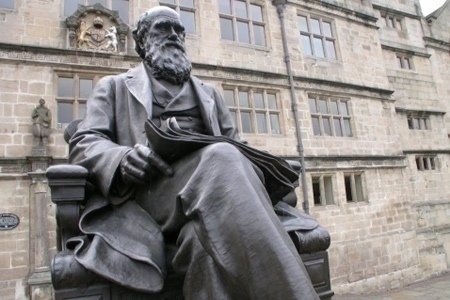
 For mobility professionals, Evolution is long past theoretical and is a part of our everyday work experience. “Adapt or die” is a grim but essential mantra in our time of volatile markets, global expansion and new customer demographics. In every specialization, relocation people are being challenged to find new customers and to serve them in unprecedented ways. Charles Darwin recognized that as an environment changes, some individuals will have characteristics that become competitive advantages, enabling them to eat better, live longer, find similarly advantaged mates and to pass along and enhance their genetic “edge.” In lower organisms, this might be a fluke of skeleton, chemistry, coloration or habitat. For our hominid ancestors, a bigger brain afforded tools, reasoning and language, leading to (for better and worse) families, tribes, nations and corporations—all means of collectivizing our efforts for security and social dominance.
Yet for all our accumulated experience and wisdom, we still see a litany of human institutions that have risen to great heights only to crash to oblivion for one reason in common: failure to recognize and adapt to a new environment: social, political, military or meteorological. It is all too human to love the status quo, even long past the point where it is so. We cling to our past successes and rely on them to be self-sustaining. It is hard for us to discard strategies, products and organizations that have simply run their course. It can seem overwhelming to reassess our world and our marketplace and to choose a new and unfamiliar course. George Clooney’s “Up in the Air” character memorably asked, “What’s in your backpack?” What are the few essentials you need to move forward? What are you still lugging that no longer serves you?
A few times a year, I get together with a similarly grizzled group of relocation industry veterans for pizza with a side-order of sarcasm and pithy observations. We all grew up and old in this business, as colleagues and competitors, and have great patience with each other’s stories, as though we’d served on the Russian Front together. Over time, though, the conversation has drifted away from contracts and mergers, more toward hip replacements, pharmaceuticals and grandkids. One of these wags now calls us the Relosauruses…wading around the tar pits, waiting for the meteor strike, poised for extinction…and that will someday be accurate, but not yet. This group is still shaping new mobility companies, policies and services with the competitive advantages of deep experience and learned perspective—keys to Darwin’s “survival of the fittest.”
One core belief of the Relosauruses is that mobility companies fail when they become self-absorbed and inwardly focused. Companies too busy reading their own press clippings miss the rest of the morning news. Growth is mistakenly equated to new client signings, when true sustainability in our maturing market depends more on retaining clients and cultivating expanded relationships. Those who will survive and thrive will be the companies that best anticipate the next wave of corporate service needs and commit to reshaping themselves toward surfing it.
I recently attended an extraordinary gathering of relocation industry pioneers, among them three men who have been relocation company presidents during different phases of mobility’s evolution. One spoke fondly of the early days when his team first saw the corporate need for managing transferees’ real estate transactions, from which grew the first home-finding network and home buyout service. Another recalled the explosive growth of mobility in the ’80s and ’90s, as corporations rapidly relinquished their in-house programs. The third has stewarded his firm through wild economic cycles while diversifying into administrative and consumer services, building robust technologies and expanding mobility services to every corner of the world. The commonality of their successes was that, despite the very different environments in which each operated, they understood their respective eras and the coming markets. They built companies that would be poised to serve clients and customers with unprecedented products and delivery methods.
How will you do that for your business? Will your relocation department sink to its doom as a cargo cult, waiting for the shipload of corporate referrals that never arrives? Will you chase direct but fruitless corporate relationships where RMCs control their customers? Or will you instead analyze the unique customer base and relocation traffic in your mobility market, and promote services that work with or without employers’ endorsement? Can you add special value to the transferee/assignee experience and distinguish your firm among competitors?
Poignantly, human mobility remains a major worldwide influence on society and business, even in the tiny Galapagos Islands that illuminated Darwin’s work. The Charles Darwin Foundation is conducting a project on “Human Mobility in the Galápagos Islands”, studying patterns of population movement, island space occupation, and the relationship of people with their environment both individually and as a group. Darwin’s intellectual heirs recognize that “human movement patterns determine the transformation of geographic space in populated areas… and provide a basis for designing efficient and sustainable transport systems.”
When we help people to move and to contribute commercially and socially, we are shaping the world to come. As mobility professionals we can choose sustained relevance by mastering knowledge and service tools that foster appreciative customers and a stronger community. And that will be a point of pride among Relosauruses when it finally is meteor time.
John B. Sculley, SCRP, is Vice President – Managing Director of RIS Consulting Group.